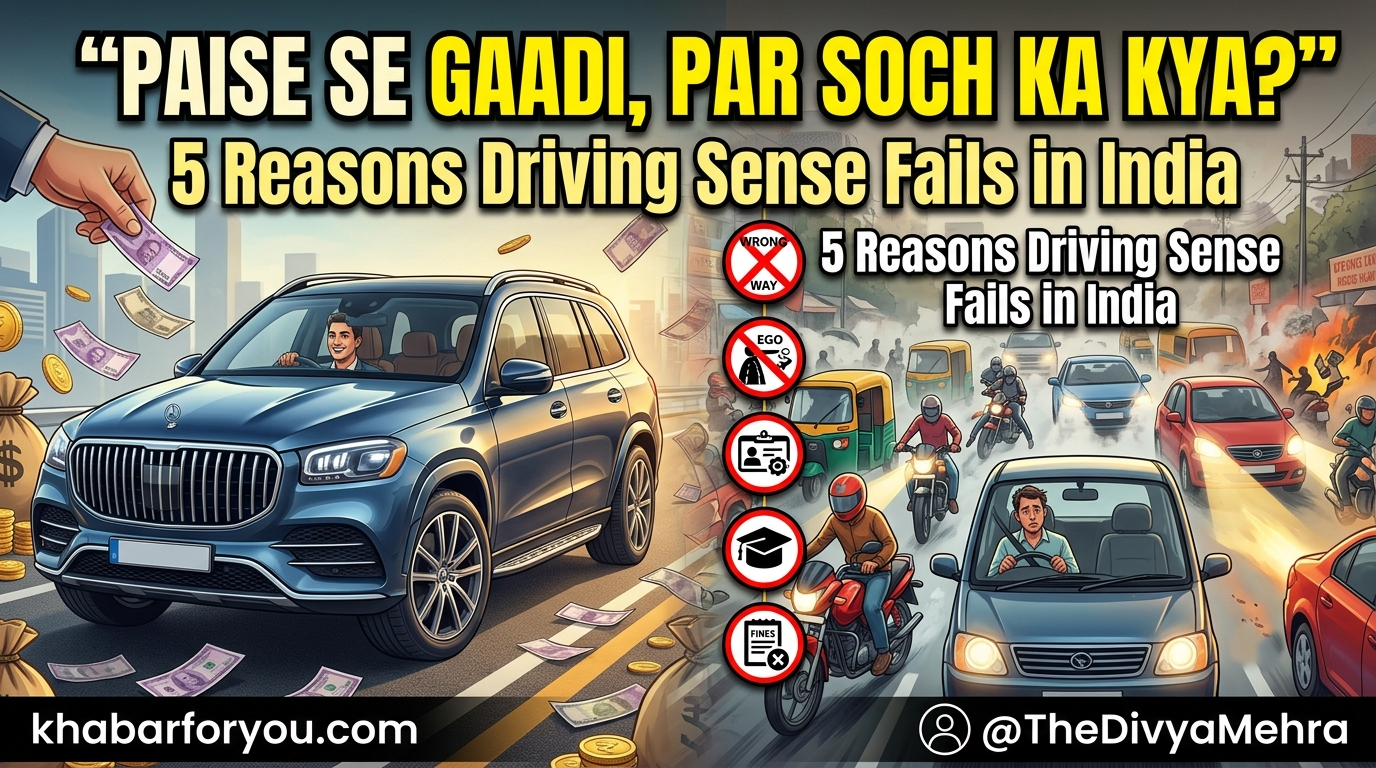
“Paise Se Gaadi, Par Soch Ka Kya?”: 5 Reasons Driving Sense Fails in India | KhabarForYou (In Hindi And English)
- DIVYA MOHAN MEHRA
- 22 Sep, 2026
- 98440

Email:-DMM@khabarforyou.com
Instagram:-@thedivyamehra

An honest evaluation of Indian traffic culture reveals a troubling contrast on our city streets and high-speed highways. Over the last two decades, India’s economic growth has put millions of modern, feature-packed vehicles onto the roads. Glistening SUVs, high-end sedans, and performance motorcycles line our thoroughfares. Yet, while vehicular engineering and personal purchasing power have advanced rapidly, our collective driving etiquette, road discipline, and civic maturity remain dangerously undeveloped.
The popular Hindi phrase "Paise se gaadi aati hai, gaadi chalane ki soch aur samajh nahi" - which translates to "Money can buy you a vehicle, but it cannot purchase the mindset or maturity required to drive it" - captures the frustrating reality faced by daily commuters across the country. From driving on the wrong side to bypass a simple U-turn to blocking ambulances with high beams blaring, bad driving behavior in India is not merely an inconvenience. It is a full-blown public safety crisis that claims thousands of lives every year.
To understand why our roads remain so chaotic despite modern infrastructure, we must analyze the deep-seated cultural, psychological, and systemic factors that drive this behavior, examine why our legal apparatus fails to curb it, and outline actionable solutions that can bring about lasting change.
Part 1: The 5 Primary Reasons Behind the Lack of Road Civic Sense in India
1. The "Status Symbol" Complex and Feudal Road Ego
In many parts of Indian society, a vehicle is viewed not merely as a practical mode of transport, but as a direct declaration of social standing, wealth, and power. The moment an individual steps into a large, expensive SUV, a psychological shift often occurs. Traffic regulations - such as lane discipline, stopping behind zebra crossings, or yielding at intersections - are frequently viewed not as safety measures, but as humbling restrictions meant only for smaller, cheaper vehicles.
Drivers frequently treat courtesy as a sign of weakness. Yielding to a pedestrian or allowing another vehicle to merge smoothly is perceived as losing face. This feudal mindset fosters an environment where aggressive maneuvering, tailgating, and honking become tools to assert dominance over fellow road users.
2. A Flawed, Compromised Driver Licensing Pipeline
The foundation of road safety rests on the quality of driver education. In India, however, obtaining a driving license has historically been treated as a administrative formality rather than a rigorous test of competence. While automated testing tracks have been introduced in several metro cities, a vast majority of drivers across the country still acquire their licenses through corrupt channels, middlemen, or superficial tests that evaluate basic vehicle movement rather than actual road understanding.
As a result, millions of active drivers lack a basic understanding of critical concepts:
- Right-of-way rules at un-signaled intersections
- Safe braking distances and the dangerous physics of tailgating
- The proper use of low-beam and high-beam headlights in urban environments
- The function of zebra crossings and absolute pedestrian priority
- Zipper merging and how to enter highways safely
When a system issues licenses to individuals who have never been taught how to navigate complex traffic dynamics, chaotic road behavior becomes an inevitable outcome.
3. Systemic Impunity and the Normalization of Minor Offenses
Human behavior is heavily influenced by immediate consequences. When illegal acts carry no visible penalty, they quickly transition from taboo behavior into standard operating procedure. In India, severe traffic violations - such as driving against the flow of traffic on a divided road, skipping red lights during non-peak hours, parking illegally on pedestrian footpaths, and driving on sidewalks - have been normalized through sheer repetition.
When a law-abiding driver observes dozens of commuters driving on the wrong side to save two minutes of fuel without facing any police intervention, a sense of systemic unfairness sets in. Over time, even cautious citizens abandon rule compliance out of sheer frustration, adopting illegal shortcuts just to survive the daily commute. When breaking the law becomes the default method of getting around, civic sense vanishes entirely.
4. Absence of Early Civic and Traffic Education
Civic responsibility is a muscle that must be trained from childhood. The Indian educational curriculum heavily emphasizes academic performance, standardized testing, and competitive examinations, while completely neglecting practical civic etiquette, public behavior, and road safety education.
In countries with exceptionally safe roads, children are taught pedestrian safety, bicycle etiquette, and basic road laws starting in primary school. In India, most individuals learn to drive informally from family members or local driving schools that focus exclusively on physical controls - clutch, brake, accelerator, and steering - without imparting any values regarding road courtesy, defensive driving, or empathy for pedestrians and cyclists.
5. Infrastructure Deficits That Induce Driver Frustration
While poor driving mindset is a major factor, flawed urban engineering actively encourages bad behavior. Poorly planned road merges, missing or obscured directional signage, unscientifically constructed speed bumps, sudden lane drops, and absurdly distant U-turns create immense friction for daily commuters.
When a driver is forced to travel two extra kilometers in heavy traffic just to make a legal U-turn because urban planners failed to construct an overhead pass or a proper turn-cut, the temptation to drive 100 meters on the wrong side increases exponentially. Chronic infrastructure failures wear down patience, triggering an "every driver for themselves" survival instinct that completely undermines civic responsibility.
Part 2: Why the Law Fails to Punish Lawbreakers Effectively
The Indian parliament passed the Motor Vehicles (Amendment) Act to introduce steep monetary penalties for traffic violations. On paper, fines were multiplied by five to ten times for offenses like drunk driving, speeding, and driving without a license. Yet, ground reality has barely changed. Understanding why these legal frameworks fail requires analyzing the structural and operational bottlenecks in our enforcement machinery.
1. The E-Challan Impunity Loophole
The transition to automated camera systems and digital e-challans was meant to remove human bias and bribery from traffic enforcement. However, it created a massive enforcement loophole. Automated cameras issue fines linked to a vehicle’s registration number, sending SMS alerts to the registered owner.
The structural flaw lies in the lack of immediate accountability. Repeat offenders accumulate dozens of unpaid e-challans over months or years without facing any immediate disruption to their daily lives. Because traffic departments lack the legal framework or technical integration to automatically suspend vehicle registrations, freeze bank accounts, or impound vehicles after a specific threshold of unpaid fines, violators simply ignore the digital citations, treating them as harmless text messages.
2. Overstretched Police Force and Selective Enforcement
Traffic police departments across major Indian cities face severe manpower shortages relative to the exploding volume of motor vehicles. A small team of officers stationed at a busy junction cannot physically manage traffic flow while simultaneously stopping and penalizing hundreds of individual violators.
Consequently, traffic police often resort to selective enforcement drives. They focus heavily on easy targets - such as checking for helmets or seatbelts at static checkpoints - while completely ignoring dynamic, highly dangerous violations taking place right in front of them, such as aggressive lane cutting, tailgating, wrong-side driving, and high-beam abuse. This selective approach destroys public respect for traffic law.
3. Judicial Backlogs and the Lok Adalat Dilution
When traffic violations are contested or left unpaid, they accumulate in special traffic courts. Due to the massive backlog in India’s judicial system, millions of pending traffic challans are periodically routed to "Lok Adalats" (people's courts) or clear-out drives.
During these sessions, authorities routinely waive off 50% to 80% of the fine amounts to clear administrative dockets. This practice inadvertently creates a moral hazard: smart lawbreakers intentionally avoid paying their e-challans on time, knowing that if they wait long enough, the government will offer a steep discount on their penalties. This completely destroys the deterrent value of heavy legal fines.
4. Political Influence, VIP Culture, and Selective Enforcement
In many parts of the country, law enforcement officers attempting to strictly enforce rules face intense pushback, verbal abuse, or political interference from influential individuals, local leaders, or high-income vehicle owners. When the public witnesses wealthy or politically connected individuals breaking laws with complete impunity, it breeds deep cynicism. The general public reaches a demoralizing conclusion: laws in India are enforced strictly against the weak and vulnerable, but function as optional suggestions for the powerful.
Part 3: 5 Actionable Solutions to Fix India’s Road Civility Crisis
Fixing the crisis on Indian roads requires a balanced approach. Heavy monetary fines alone do not change human behavior; long-term progress requires strict administrative consequences, intelligent technology integration, and continuous public education.
1. Implement a Strict Point-Based Licensing and Suspension System
Monetary fines mean very little to affluent drivers, but losing the legal right to drive impacts everyone equally. India must immediately implement a unified, national point-based demerit system directly linked to every driver’s license database.
Under this system:
- Every driver starts with a clean score.
- Serious offenses - such as wrong-side driving, jumping red lights, drunk driving, or driving on sidewalks - add immediate demerit points to the offender's license.
- Accumulating a specific number of points within a 24-month period must trigger an automatic 6-month license suspension, accompanied by mandatory driving re-education and a rigorous retake of the driver's test before reinstatement.
- Driving on a suspended license should lead to mandatory vehicle impoundment and short-term imprisonment.
When drivers realize that reckless behavior threatens their mobility rather than just their wallet, road discipline improves dramatically.
2. Introduce Mandatory Civic and Road Etiquette Training in Schools
To build a safer road culture long-term, traffic education must start early. The Ministry of Education, alongside state boards, should integrate mandatory road safety and civic etiquette modules into middle school and high school curriculums.
This education should move beyond simple sign identification to focus on:
- The moral and social responsibility of holding a driving license.
- Understanding pedestrian rights and vulnerable road users (cyclists, senior citizens, children).
- The physics of vehicle crashes to break the illusion of speed and invincibility.
- First-responder awareness, teaching students how to safely assist accident victims under "Good Samaritan" protection laws.
Building respect for the law early in life creates adults who view driving as a shared civic responsibility rather than a personal power play.
3. Link Vehicle Insurance Premiums directly to Driver Violation Records
Financial incentives are powerful drivers of human behavior. India should integrate the Ministry of Road Transport and Highways (MoRTH) digital database directly with the Insurance Regulatory and Development Authority (IRDAI).
By adopting a dynamic risk-based insurance framework:
- Drivers who maintain a clean record with zero traffic violations receive significant discounts on their annual vehicle insurance renewals.
- Conversely, drivers who accumulate multiple e-challans, speeding tickets, or hazardous driving citations face steep, mandatory surcharges on their annual insurance premiums.
When a reckless driver realizes that their illegal driving habits will double or triple their annual insurance costs, maintaining good road sense becomes a matter of financial self-interest.
4. Leverage Citizen Citizen Reporting Mobile Apps with Verified e-Challans
Since police personnel cannot be present on every street corner, city traffic police departments should empower the public through verified citizen-reporting smartphone applications.
Using these platforms:
- Citizens can capture clear geotagged and timestamped photographs or video footage of severe traffic violations - such as wrong-side driving, sidewalk parking, or blocking emergency vehicles.
- Submissions are processed through an automated verification portal where traffic officers validate the evidence and issue an immediate, legally binding e-challan to the registered vehicle owner.
- To prevent misuse, the system can use automated license plate recognition (ALPR) and location metadata.
Knowing that any surrounding driver, pedestrian, or shopkeeper could record a violation creates a powerful crowd-sourced deterrent against reckless behavior.
5. Transition to "Self-Explaining" Road Design and Self-Enforcing Infrastructure
Human error and poor decisions can be reduced through intelligent urban engineering. Municipal authorities must redesign urban roads using "self-explaining" engineering principles that make rule-breaking physically difficult or impossible.
Key infrastructure solutions include:
Physical Median Barriers: Installing continuous physical dividers at high-risk junctions to completely eliminate the physical ability of vehicles to drive on the wrong side.
Raised Pedestrian Crossings: Elevating zebra crossings to sidewalk height, forcing approaching vehicles to slow down naturally without relying solely on brake compliance.
Standardized and Unobstructed Signage: Placing high-visibility, retro-reflective lane markings and clear overhead signage well ahead of complex merges and intersections.
Dedicated Non-Motorized Transport (NMT) Lanes: Physically separating pedestrians and cyclists from high-speed motor traffic using bollards or elevated curbs.
When roads are engineered intuitively, compliant driving becomes the easiest, safest, and most natural choice for every road user.
Conclusion
The state of a country's roads is a direct mirror of its societal health, civic empathy, and respect for human life. The growing frustration encapsulated by "Paise se gaadi aati hai, gaadi chalane ki soch aur samajh nahi" points to a clear problem: rising personal wealth must be matched by equal progress in social responsibility.
Solving India’s road civility crisis will not happen through heavy monetary fines alone, nor can it be achieved overnight. It requires a sustained commitment across multiple fronts - upgrading driver licensing standards, fixing legislative enforcement loopholes, redesigning forgiving infrastructure, and instilling civic values in future generations. Only when we shift our collective perspective to view driving as a privilege attached to serious civic responsibilities can Indian roads become safe, orderly, and respectful spaces for everyone.
------------------------
भारतीय यातायात संस्कृति (Traffic Culture) का निष्पक्ष विश्लेषण हमारी चमचमाती सड़कों और हाईवे पर एक कड़वी सच्चाई को उजागर करता है। पिछले दो दशकों में भारत की आर्थिक प्रगति के कारण करोड़ों आधुनिक, अत्याधुनिक फीचर्स वाली गाड़ियां सड़कों पर उतरी हैं। हर तरफ बड़ी SUVs, लग्जरी कारें और तेज़ रफ्तार मोटरसाइकिलें दिखाई देती हैं। हालांकि, गाड़ियों की तकनीक और लोगों की खरीदने की क्षमता तो तेजी से बढ़ी है, लेकिन सड़क अनुशासन, ड्राइविंग शिष्टाचार और नागरिक परिपक्वता (Civic Sense) वहीं की वहीं ठहर गई है।
आम बोलचाल की कहावत - "पैसे से गाड़ी आती है, गाड़ी चलाने की सोच और समझ नहीं" - हर दिन सफर करने वाले आम नागरिक की पीड़ा को दर्शाती है। थोड़ा सा समय या ईंधन बचाने के लिए गलत दिशा (Wrong Side) में गाड़ी चलाना, हाई-बीम लाइट का बेजा इस्तेमाल करना, और एम्बुलेंस तक को रास्ता न देना अब सिर्फ लापरवाही नहीं, बल्कि एक गंभीर सार्वजनिक सुरक्षा संकट बन चुका है जो हर साल हजारों जानें लेता है।
यह समझने के लिए कि आधुनिक इंफ्रास्ट्रक्चर के बावजूद हमारी सड़कें इतनी अराजक क्यों हैं, हमें इसके पीछे के सामाजिक, मनोवैज्ञानिक और व्यवस्थागत कारणों का विश्लेषण करना होगा, यह देखना होगा कि कानून क्यों नाकाम हो रहा है, और उन व्यावहारिक समाधानों को खोजना होगा जो बदलाव ला सकें।
भारत में रोड सिविक सेंस की कमी के 5 मुख्य कारण
1. "स्टेटस सिंबल" का घमंड और सामंती सोच (Status Symbol & Feudal Ego)
भारतीय समाज के कई हिस्सों में गाड़ी को सिर्फ आने-जाने का साधन नहीं, बल्कि अपनी सामाजिक हैसियत, धन और ताकत का प्रदर्शन माना जाता है। जैसे ही कोई व्यक्ति एक बड़ी या महंगी गाड़ी में बैठता है, उसके व्यवहार में एक मनोवैज्ञानिक बदलाव आता है। लेन में चलना, जेब्रा क्रॉसिंग पर रुकना या चौराहों पर दूसरों को रास्ता देना - इन्हें सुरक्षा नियम मानने के बजाय अपनी शान के खिलाफ समझा जाता है।
गाड़ी चालक अक्सर दूसरों को रास्ता देने या विनम्रता दिखाने को कमजोरी मानते हैं। इस सामंती सोच के कारण ही सड़कों पर आक्रामक ड्राइविंग, टेलगेटिंग (सटाकर गाड़ी चलाना) और बेवजह हॉर्न बजाकर दूसरों पर धौंस जमाने की प्रवृत्ति पैदा होती है।
2. ड्राइविंग लाइसेंस देने की दोषपूर्ण प्रणाली
सड़क सुरक्षा की नींव इस बात पर टिकी होती है कि चालक को कैसी शिक्षा मिली है। हालांकि, भारत में लंबे समय से ड्राइविंग लाइसेंस हासिल करना एक औपचारिक कागजी कार्रवाई या भ्रष्टाचार का जरिया रहा है। यद्यपि कई बड़े शहरों में ऑटोमेटेड ड्राइविंग ट्रैक बनाए गए हैं, फिर भी देश के एक बड़े हिस्से में लोग बिचौलियों के माध्यम से या केवल गाड़ी आगे-पीछे करके लाइसेंस प्राप्त कर लेते हैं।
नतीजतन, लाखों चालकों को बुनियादी बातों की जानकारी ही नहीं होती, जैसे:
- बिना सिग्नल वाले चौराहों पर राइट-ऑफ़-वे (किसका पहला अधिकार है) के नियम
- सुरक्षित दूरी बनाए रखना (Safe Braking Distance)
- शहर के भीतर लो-बीम और हाई-बीम लाइट का सही उपयोग
- जेब्रा क्रॉसिंग और पैदल यात्रियों का प्राथमिक अधिकार
- हाईवे पर सुरक्षित तरीके से लेन बदलना (Zipper Merging)
जब व्यवस्था ऐसे लोगों को लाइसेंस बांटती है जिन्हें सड़क के नियमों का ज्ञान ही नहीं है, तो सड़कों पर अराजकता फैलना स्वाभाविक है।
3. नियमों के उल्लंघन को सामान्य मान लेना (Normalization of Violations)
जब किसी अवैध काम पर तुरंत कोई कार्रवाई नहीं होती, तो वह व्यवहार धीरे-धीरे समाज में सामान्य मान लिया जाता है। भारत में गलत दिशा में गाड़ी चलाना, रेड लाइट तोड़ना, फुटपाथ पर पार्किंग करना या फुटपाथ पर बाइक चढ़ाना अब कोई बड़ी बात नहीं मानी जाती।
जब एक नियम का पालन करने वाला नागरिक देखता है कि दर्जनों लोग रोज गलत दिशा में गाड़ी चलाकर बिना किसी सजा के निकल जाते हैं, तो उसका नियम-पालन से भरोसा उठ जाता है। समय के साथ, सीधे रास्ते पर चलने वाले लोग भी हताश होकर वही गलत रास्ते अपनाने लगते हैं। जब कानून तोड़ना ही स्वाभाविक बन जाए, तो सिविक सेंस पूरी तरह खत्म हो जाता है।
4. शुरुआती शिक्षा में ट्रैफिक और सिविक सेंस की अनुपस्थिति
नागरिक जिम्मेदारियां बचपन से सिखाई जाती हैं। भारतीय शिक्षा प्रणाली का पूरा ध्यान अकादमिक अंकों, परीक्षाओं और डिग्रियों पर रहता है, जबकि व्यावहारिक नागरिक कर्तव्यों, सार्वजनिक व्यवहार और सड़क सुरक्षा शिक्षा को पूरी तरह नजरअंदाज कर दिया जाता है।
सड़क सुरक्षा के मामले में अव्वल देशों में बच्चों को प्राथमिक स्कूल से ही पैदल चलने के नियम, साइकिल चलाने का तरीका और सड़क के नियम सिखाए जाते हैं। इसके विपरीत, भारत में लोग अनौपचारिक रूप से परिवार के सदस्यों या स्थानीय ड्राइविंग स्कूलों से केवल गाड़ी के एक्सीलेटर, ब्रेक और क्लच पर नियंत्रण पाना सीखते हैं। उन्हें सड़क पर शिष्टाचार, सुरक्षित ड्राइविंग या पैदल यात्रियों के प्रति सहानुभूति जैसी बातें कभी नहीं सिखाई जातीं।
5. खराब रोड इंजीनियरिंग और इंफ्रास्ट्रक्चर की कमियां
खराब मानसिकता के साथ-साथ हमारी सड़कों की दोषपूर्ण बनावट भी लोगों को नियम तोड़ने के लिए उकसाती है। बिना सोच-समझकर बनाए गए कट, दिशा बताने वाले बोर्ड का न होना, अवैज्ञानिक स्पीड ब्रेकर, अचानक बंद होने वाली लेन और बहुत दूरी पर बनाए गए यू-टर्न चालकों में झुंझलाहट पैदा करते हैं।
जब किसी ड्राइवर को एक वैध यू-टर्न लेने के लिए भारी ट्रैफिक में दो किलोमीटर दूर जाना पड़े, केवल इसलिए कि सड़क बनाने वालों ने वहां कोई सही कट या ओवरपास नहीं बनाया, तो उसके गलत दिशा में गाड़ी चलाने की संभावना कई गुना बढ़ जाती है। इंफ्रास्ट्रक्चर की यह नाकामी चालकों के धैर्य को तोड़ती है, जिससे उनमें नियम तोड़ने की प्रवृत्ति पनपती है।
नियम तोड़ने वालों को कानून की सजा क्यों नहीं मिल पाती?
मोटर वाहन (संशोधन) अधिनियम के तहत यातायात नियमों के उल्लंघन पर भारी जुर्माने का प्रावधान किया गया। कागजों पर शराब पीकर गाड़ी चलाने, ओवरस्पीडिंग और बिना लाइसेंस गाड़ी चलाने पर चालान 5 से 10 गुना तक बढ़ा दिए गए। फिर भी, धरातल पर स्थिति में कोई खास सुधार नहीं आया। इसके पीछे प्रशासनिक और operational बाधाएं जिम्मेदार हैं:
1. ई-चालान (E-Challan) प्रणाली की कमियां
कैमरों और ई-चालान प्रणाली की शुरुआत इसलिए की गई थी ताकि मानवीय हस्तक्षेप और रिश्वतखोरी को खत्म किया जा सके। लेकिन इसने लागू करने के स्तर पर एक नई कमी पैदा कर दी। स्वचालित कैमरे गाड़ी के नंबर प्लेट के आधार पर डिजिटल चालान काटकर पंजीकृत मालिक के मोबाइल पर मैसेज भेज देते हैं।
समस्या यह है कि इस प्रणाली में तुरंत कोई डर या जवाबदेही नहीं होती। लोग महीनों और सालों तक दर्जनों ई-चालान पेंडिंग रखते हैं और बेखौफ होकर गाड़ियां चलाते रहते हैं। ट्रैफिक पुलिस के पास ऐसा कोई तकनीकी या कानूनी ढांचा नहीं है जिससे चालान न भरने पर गाड़ी का रजिस्ट्रेशन तुरंत रद्द किया जा सके, बैंक खाते से पैसे काटे जा सकें या गाड़ी को जब्त किया जा सके। लोग इन डिजिटल संदेशों को अनदेखा कर देते हैं।
2. ट्रैफिक पुलिस बल की भारी कमी और चुनिंदा कार्रवाई
भारत के प्रमुख शहरों में गाड़ियों की बढ़ती संख्या की तुलना में ट्रैफिक पुलिस की संख्या बहुत कम है। एक व्यस्त चौराहे पर तैनात दो-तीन पुलिसकर्मी ट्रैफिक संभालने के साथ-साथ हर नियम तोड़ने वाले को रोककर चालान नहीं काट सकते।
परिणामस्वरूप, पुलिस अक्सर आसान टारगेट चुनती है - जैसे चेकिंग पॉइंट लगाकर केवल हेलमेट या सीटबेल्ट की जांच करना। इस दौरान आक्रामक रूप से लेन बदलना, सटाकर गाड़ी चलाना, गलत दिशा में जाना और हाई-बीम का गलत इस्तेमाल जैसी खतरनाक गतियों पर कोई ध्यान नहीं दिया जाता। इस चुनिंदा कार्रवाई से कानून का डर खत्म हो जाता है।
3. अदालतों में मुकदमों का अंबार और लोक अदालतों में छूट
जब ई-चालान जमा नहीं होते या उन्हें चुनौती दी जाती है, तो वे विशेष ट्रैफिक अदालतों में चले जाते हैं। न्यायिक प्रणाली पर पहले से ही भारी दबाव होने के कारण लाखों चालान पेंडिंग पड़े रहते हैं। इन मामलों को निपटाने के लिए समय-समय पर 'लोक अदालतें' लगाई जाती हैं।
लोक अदालतों में मामलों को सुलझाने के लिए चालान की राशि पर 50% से 80% तक की भारी छूट दे दी जाती है। इससे नियम तोड़ने वालों को एक गलत संदेश मिलता है: चालान समय पर भरने के बजाय इंतजार करो, क्योंकि बाद में सरकार खुद ही जुर्माना कम कर देगी। यह व्यवस्था भारी जुर्माने के डर को पूरी तरह खत्म कर देती है।
4. राजनीतिक प्रभाव और वीआईपी कल्चर (VIP Culture)
देश के कई हिस्सों में जब पुलिस अधिकारी नियमों को सख्ती से लागू करने की कोशिश करते हैं, तो उन्हें प्रभावशाली लोगों, स्थानीय नेताओं या रसूखदार गाड़ी मालिकों के विरोध का सामना करना पड़ता है। जब आम जनता किसी रसूखदार व्यक्ति को नियम तोड़कर आराम से निकलते हुए देखती है, तो उसका कानून व्यवस्था से भरोसा उठ जाता है। जनता में यह संदेश जाता है कि नियम केवल आम और कमजोर नागरिकों के लिए हैं, ताकतवर लोगों के लिए नहीं।
रोड सिविक सेंस और ट्रैफिक सुधार के 5 आसान एवं असरदार उपाय
सड़कों पर स्थिति सुधारने के लिए केवल भारी जुर्माना लगाना काफी नहीं है। इसके लिए कड़े प्रशासनिक कदम, आधुनिक तकनीक और निरंतर जन-जागरूकता का संतुलन जरूरी है।
1. डिमेरिट पॉइंट सिस्टम और लाइसेंस निलंबन की सख्त व्यवस्था
पैसे वालों के लिए भारी जुर्माना कोई बड़ी बात नहीं होती, लेकिन गाड़ी चलाने का अधिकार छीन लेना हर व्यक्ति पर एक समान असर डालता है। भारत को तुरंत एक राष्ट्रीय स्तर का डिमेरिट पॉइंट सिस्टम (Point-Based Demerit System) लागू करना चाहिए, जो सीधे ड्राइविंग लाइसेंस डेटाबेस से जुड़ा हो।
यह व्यवस्था ऐसे काम करेगी:
- हर ड्राइवर का लाइसेंस एक निश्चित क्रेडिट अंक के साथ शुरू होगा।
- गलत दिशा में गाड़ी चलाने, रेड लाइट तोड़ने, शराब पीकर गाड़ी चलाने जैसी हर गलती पर लाइसेंस में डिमेरिट पॉइंट्स जुड़ेंगे।
- यदि 2 साल के भीतर किसी ड्राइवर के पॉइंट्स एक तय सीमा को पार कर जाते हैं, तो उसका लाइसेंस अपने आप 6 महीने के लिए निलंबित (Suspend) कर दिया जाएगा।
- निलंबन के बाद लाइसेंस वापस पाने के लिए चालक को दोबारा ट्रेनिंग लेनी होगी और ड्राइविंग टेस्ट पास करना होगा।
- निलंबित लाइसेंस पर गाड़ी चलाते पकड़े जाने पर गाड़ी की जब्ती और जेल का प्रावधान होना चाहिए।
जब लोगों को यह समझ आएगा कि नियम तोड़ने से उनका लाइसेंस छिन सकता है, तो वे अपने आप सतर्क हो जाएंगे।
2. स्कूलों और कॉलेजों में सिविक और ट्रैफिक सेंस की अनिवार्य शिक्षा
स्थायी बदलाव के लिए बच्चों को छोटी उम्र से ही सही आदतें सिखानी होंगी। शिक्षा मंत्रालय और राज्य शिक्षा बोर्डों को स्कूल और कॉलेज के पाठ्यक्रम में सड़क सुरक्षा और नागरिक शिष्टाचार का विषय अनिवार्य रूप से शामिल करना चाहिए।
इसमें केवल ट्रैफिक संकेतों की जानकारी नहीं, बल्कि निम्नलिखित बातों पर जोर होना चाहिए:
- ड्राइविंग लाइसेंस रखने का सामाजिक और नैतिक दायित्व
- पैदल यात्रियों, बुजुर्गों और साइकिल चालकों के अधिकारों का सम्मान
- दुर्घटनाओं के पीछे का भौतिक विज्ञान (Physics), ताकि लोग रफ्तार के भ्रम से बाहर निकल सकें
- 'गुड सेमेरिटन' (Good Samaritan) नियमों की जानकारी, ताकि छात्र दुर्घटना पीड़ितों की मदद करने से न डरें
बचपन से ही कानून और दूसरों के अधिकारों का सम्मान करने की आदत आगे चलकर एक जिम्मेदार नागरिक बनाती है।
3. गाड़ियों के बीमा (Insurance Premium) को ट्रैफिक रिकॉर्ड से जोड़ना
वित्तीय लाभ और हानि इंसान के व्यवहार को तेजी से बदलते हैं। भारत सरकार (MoRTH) के डेटाबेस को बीमा नियामक प्राधिकरण (IRDAI) के साथ पूरी तरह एकीकृत किया जाना चाहिए।
इस व्यवस्था के तहत:
- जिन चालकों का रिकॉर्ड साफ होगा और जिन पर कोई चालान नहीं होगा, उन्हें वार्षिक इंश्योरेंस रिन्यूअल पर विशेष छूट (Discount) दी जाएगी।
- इसके विपरीत, जिन चालकों के नाम पर बार-बार ई-चालान या ओवरस्पीडिंग दर्ज होगी, उनकी गाड़ी के इंश्योरेंस का प्रीमियम बढ़ा दिया जाएगा।
जब गलत ड्राइविंग का असर सीधे जेब पर पड़ेगा और हर साल बीमा महंगा होता जाएगा, तो लोग अपने आप नियम से गाड़ी चलाएंगे।
4. आम जनता के लिए सिटीजन रिपोर्टिंग मोबाइल ऐप (Citizen Reporting App)
पुलिस हर जगह मौजूद नहीं रह सकती, इसलिए जनता को इस व्यवस्था का हिस्सा बनाना होगा। सभी राज्यों की ट्रैफिक पुलिस को एक आधुनिक 'सिटीजन रिपोर्टिंग ऐप' शुरू करना चाहिए।
इसके माध्यम से:
- आम नागरिक गलत दिशा में गाड़ी चलाने, फुटपाथ पर पार्किंग करने या एम्बुलेंस का रास्ता रोकने जैसी गंभीर गलतियों की फोटो या वीडियो बनाकर ऐप पर अपलोड कर सकते हैं।
- फोटो में जीपीएस लोकेशन और समय अपने आप दर्ज होगा।
- ट्रैफिक पुलिस का वेरिफिकेशन सेल इन तस्वीरों की जांच करके सीधे गाड़ी मालिक को कानूनी रूप से वैध ई-चालान जारी करेगा।
जब चालकों को यह अहसास होगा कि आसपास मौजूद कोई भी नागरिक या पैदल यात्री उनकी गलती को रिकॉर्ड कर सकता है, तो वे सड़कों पर मनमानी करने से बचेंगे।
5. सेल्फ-एक्सप्लेनिंग रोड डिजाइन और सुरक्षित इंफ्रास्ट्रक्चर
इंसानी गलतियों को बेहतर रोड इंजीनियरिंग के जरिए काफी हद तक रोका जा सकता है। नगर निगमों और सड़क निर्माण एजेंसियों को ऐसे "Self-Explaining" रोड डिजाइन अपनाने होंगे जो नियम तोड़ना शारीरिक रूप से कठिन बना दें।
मुख्य इंफ्रास्ट्रक्चर समाधान:
फिजिकल डिवाइडर: संवेदनशील सड़कों पर मजबूत डिवाइडर लगाना ताकि कोई भी चाहकर भी गलत दिशा में गाड़ी न घुसा सके।
उभरी हुई जेब्रा क्रॉसिंग (Raised Pedestrian Crossings): जेब्रा क्रॉसिंग को फुटपाथ की ऊंचाई के बराबर ऊंचा बनाना, जिससे गाड़ियां अपने आप धीमी हो जाएं।
स्पष्ट और रात में चमकने वाले साइनबोर्ड: लेन मार्किंग और यू-टर्न के संकेत काफी पहले से स्पष्ट रूप से दिखाई देने चाहिए।
पैदल यात्रियों और साइकिल चालकों के लिए अलग लेन: पैदल चलने वालों को ट्रैफिक से अलग सुरक्षित रास्ता देना।
जब सड़कें सही तरीके से बनाई जाएंगी, तो नियमों का पालन करना सबसे आसान और स्वाभाविक विकल्प बन जाएगा।
निष्कर्ष
किसी देश की सड़कों का हाल उस समाज की मानसिकता, नागरिक सहानुभूति और मानव जीवन के प्रति सम्मान का दर्पण होता है। "पैसे से गाड़ी आती है, गाड़ी चलाने की सोच और समझ नहीं" का बढ़ता दर्द यह दर्शाता है कि केवल व्यक्तिगत संपत्ति बढ़ना काफी नहीं है, उसके साथ सामाजिक जिम्मेदारी का बढ़ना भी उतना ही जरूरी है।
भारत की सड़कों पर फैली अराजकता को केवल भारी चालान लगाकर रातों-रात खत्म नहीं किया जा सकता। इसके लिए एक एकीकृत प्रयास की आवश्यकता है - ड्राइविंग लाइसेंसिंग प्रक्रिया को पारदर्शी और कठिन बनाना, कानून के प्रवर्तन में मौजूद कमियों को दूर करना, सड़कों की बनावट में सुधार करना और आने वाली पीढ़ी में नागरिक कर्तव्यों का बीजारोपण करना। जब हम ड्राइविंग को केवल एक अधिकार नहीं, बल्कि एक जिम्मेदारी मानेंगे, तभी हमारी सड़कें सभी के लिए सुरक्षित बन पाएंगी।
Khabar For You
बिज़नेस | स्पोर्ट्स | लाइफस्टाइल | पॉलिटिक्स | एंटरटेनमेंट | टेक्नोलॉजी | देश और दुनिया की ताजातरीन खबरों के लिए बने रहिए khabarforyou.com के साथ।
ताज़ा अपडेट्स सीधे अपने ईमेल पर पाने के लिए हमारे न्यूज़लेटर को तुरंत सब्सक्राइब करें!
क्या आपके पास भी है कोई खबर या वीडियो?
अगर आपके पास कोई ताज़ा समाचार या जानकारी है, तो हमें तुरंत व्हाट्सएप या कॉल करें: 8502024040
सुनिए नवीनतम PODCAST - केवल The FM Yours पर!
ट्रेंडिंग खबरें पढ़ने के लिए यहां क्लिक करें
#KFY #KFYNews #KhabarForYou #KhabarForYou.com
© 2026 Khabar For You. All Rights Reserved.
Leave a Reply
Your email address will not be published. Required fields are marked *
Search
Category